Talking points
- Delegations from Kyiv and the Kremlin met on the Belarusian border early on Tuesday morning to discuss a possible ceasefire.
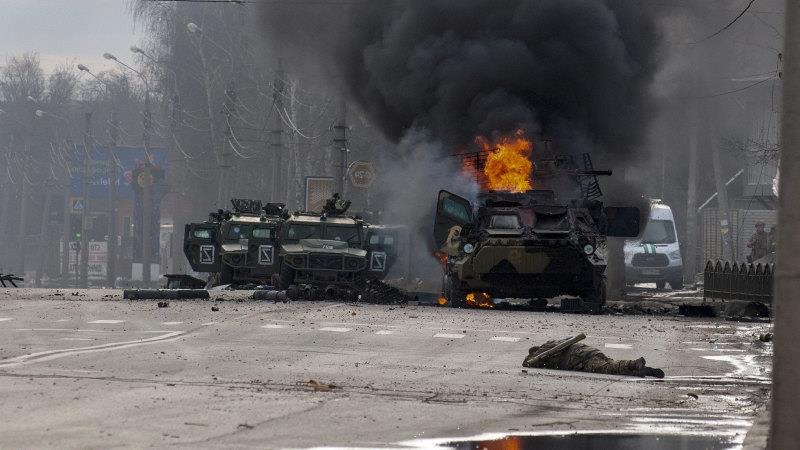
- Dozens of deaths, hundreds of injuries in a Russian rocket attack on the eastern city of Kharkiv.
- Convoy of Russian armed forces is also moving closer to Kyiv, stretched out over at least 10km.
- About 500,000 people have fled in recent days, crossing Ukraine’s border with Romania, Poland and Moldova.
- Ukraine seeks immediate accession to European Union in response to Russia’s invasion.
London: Emergency ceasefire talks in Ukraine have been overshadowed by dozens of deaths and hundreds of injuries in a Russian rocket attack on the eastern city of Kharkiv amid growing condemnation and hardline sanctions against Moscow’s invasion.
Delegations from Kyiv and the Kremlin met on the Belarusian border early on Tuesday morning Australian time with Ukrainian president Volodymyr Zelensky demanding an immediate ceasefire and that all Russian troops leave his country ahead of the talks.

A Russian armoured personnel carrier burns in Kharkiv – with what appears to be a body in the foreground.Credit:AP
Ukraine had initially rejected attending talks in Belarus because Russian forces stationed there have joined the invasion. But then Ukrainian officials agreed to send a delegation to the meeting in Gomel, a city near the borders of Russia and Ukraine. The talks ended after several hours without a clear resolution but are expected to resume again in coming days.
Mykhailo Podolyak, an adviser to the Ukraine President, gave few details except to say that the talks focused on a possible cease-fire and that a second round could take place “in the near future”.
Earlier, Ukrainian officials accused Russian forces of launching a barrage of rockets on a residential neighbourhood in Ukraine’s second-largest city, killing dozens of civilians, just as officials were preparing to meet for talks in Belarus. A large convoy of Russian armed forces is also moving closer to Kyiv, with the convoy is stretched out over at least 10km.

The northern end of a convoy of Russian vehicles southeast of Ivankiv, Ukraine.Credit:Maxar
The convoy is about 25 km from Kyiv’s city centre.
The conflict is causing a major humanitarian crisis for Europe, with hundreds of thousands of refugees crossing Ukraine’s border with Romania, Poland and Moldova. The United Nations estimates about 500,000 people have fled in recent days, making it the most intense week of human flight within Europe’s borders since at least the Balkan wars of the 1990s.
In growing international condemnation of Vladimir Putin’s actions, Switzerland – a favourite destination for Russian oligarchs and their money – has announced it will freeze Russian financial assets in the country, setting aside a deeply rooted tradition of neutrality to join the European Union and a growing number of nations seeking to penalise Moscow for its invasion.
The International Olympic Committee has also recommended that athletes from Russia and Belarus be blocked from competitions around the world, while football’s governing body was expected to announced Russia would be banned from this year’s World Cup in Qatar.
In a passionate speech aimed at rallying Ukrainians to continue to defend their country and encouraging further international support, Zelensky urged the European Union to grant his country immediate accession to the bloc in response to Russia’s invasion.
He thanked EU countries that had decided to supply arms to Ukraine over the past few days and said he had spoken to Ursula von der Leyen, president of the European Commission, to urge her to take “even stronger steps”.
“We appeal to the European Union for Ukraine’s immediate accession under a new special procedure,” Zelensky said in a video broadcast from the capital, Kyiv. “Our goal is to stand alongside all Europeans and, most importantly, to stand on their level.“
US officials expect Russian forces to attempt to encircle Kyiv in the coming days and have warned their actions could become more aggressive because of their frustrations with their slow advance on the city so far.
British Foreign Secretary Liz Truss said that she would meet US Secretary of State Antony Blinken this week to discuss the crisis in Europe and actions against Russia.
“He’s (Blinken’s) going to be travelling to Europe this week. I’ll be meeting him. I’ll also be in the United States the following week,” Truss told Parliament.
With agencies
Get a note directly from our foreign correspondents on what’s making headlines around the world. Sign up for the weekly What in the World newsletter here.
Most Viewed in World
From our partners
Source: Read Full Article